Does MVHR Only Work in New Build Homes?
It’s one of the most common questions we hear:
“Isn’t MVHR just for new builds?”
The short answer is no. Mechanical Ventilation with Heat Recovery (MVHR) can absolutely be installed in existing properties. But, as with most building services, the reality is a little more nuanced.
MVHR Isn’t About building age, it’s about airtightness
There’s a perception that MVHR is only suitable for modern homes, but that’s not quite right.
What really determines whether MVHR will work effectively is how airtight the property is, not when it was built.
Traditionally, older homes relied on natural ventilation, draughts, chimneys and gaps in the building fabric allowed air to circulate freely. But as soon as you improve a property with:
- New windows and doors
- Insulation upgrades
- Sealing works
…that “natural” airflow is reduced or disappears altogether.
That’s where MVHR comes into its own, providing consistent, controlled ventilation while recovering heat that would otherwise be lost.
Yes, MVHR can be retrofitted
Retrofitting MVHR into an existing home is entirely possible, and it’s becoming increasingly common across the UK.
Even traditional housing stock such as Victorian terraces and 1930s semis-detached houses can accommodate MVHR with the right design and planning.
But it’s important to be upfront about the practical considerations.
The Main Challenge: Ductwork
The biggest difference between new build and retrofit isn’t whether MVHR works, it’s how easy it is to install?
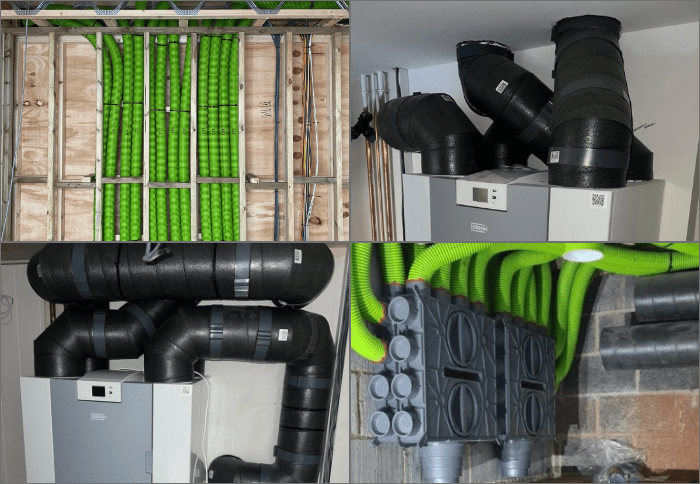
In a new build, duct routes are designed into the property from the outset. In an existing home, those routes have to be created afterwards.
That can mean:
- Running ducts through ceilings, floors or boxed-in areas
- Working around structural constraints and existing layouts
- Making allowances for limited space in lofts or voids
In some cases, this can be disruptive, depending on the type of property and the level of finish required.
That said, with good design, installations can often be integrated neatly into cupboards, ceiling voids or service runs.
When Is the Best Time to Install MVHR?
If you’re considering MVHR for an existing property, timing is key.
The ideal opportunity is during renovation or remodelling work. That’s when:
- Ceilings or walls may already be opened up
- Other upgrades (insulation, windows, airtightness improvements) are taking place
- Access for ductwork is far easier
In short, if you’re already doing the “hard work” on the building fabric, it makes sense to include MVHR at the same time.
A Practical Approach for Existing Homes
For retrofit projects, the goal isn’t perfection, it’s finding the right balance between:
- Airtightness improvements
- Practical installation routes
- System performance
MVHR performs best in homes that have been made reasonably airtight, but it doesn’t require a brand-new building to deliver real benefits.
With a considered approach, it can significantly improve:
- Indoor air quality
- Comfort
- Energy efficiency
The Bottom Line
MVHR is not limited to new builds.
It’s a solution for any property where you want controlled ventilation and improved energy performance.
The key points to remember are:
- MVHR works in both new and existing homes
- Airtightness matters more than age
- Retrofit is possible, but ductwork needs careful planning
- Renovation projects are the perfect opportunity to install it
At Clarke Talbot Renewables, we take a practical, design-led approach to renewable ventilation and heating, helping you understand whether MVHR is right for your home, and how best to integrate it.