I Don’t Have a Garden, Can I Still Have a Heat Pump?
It’s one of the most common questions we hear:
“I don’t have a garden. Does that rule me out for a heat pump?”
The short answer is no, it absolutely doesn’t.
But the longer answer is far more interesting and it speaks to a wider misunderstanding about how modern heating systems actually work.
The Garden Myth
For years, heat pumps have been associated with large homes, rural properties, and generous outdoor space. That perception mostly stems from earlier ground source systems, which do require significant land for underground loops.
But today, the majority of installations in the UK are air source heat pumps—and they’re far more flexible than many people realise.
In fact, recent changes to UK planning rules have made it even easier to install them in tighter, urban spaces, including terraced properties where external space is limited.
So, if your mental image of a heat pump involves sacrificing half your garden, it’s worth resetting that expectation.
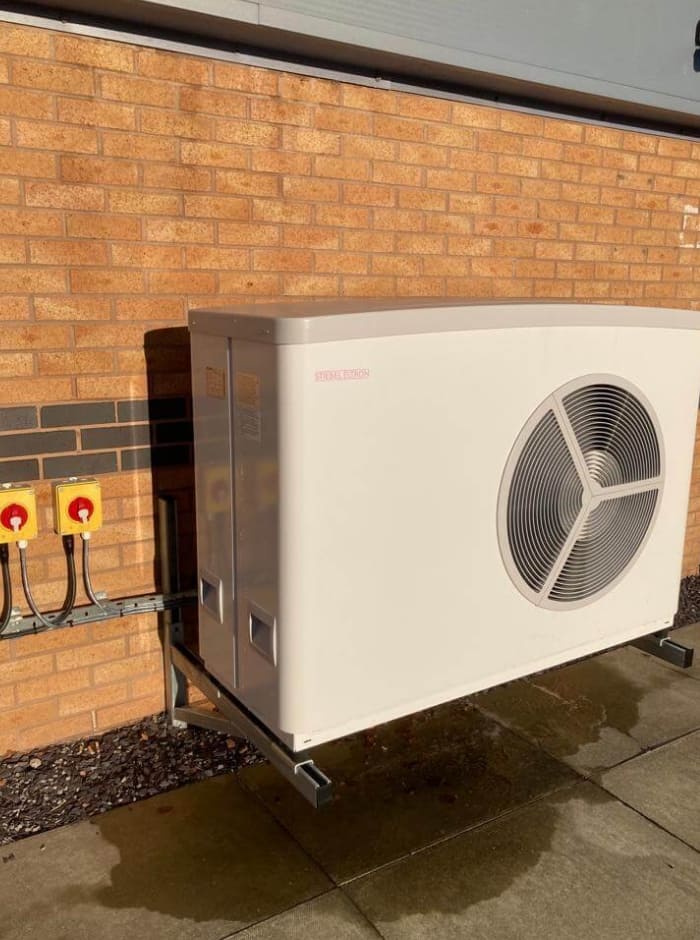
Option 1: Wall-Mounted Air Source Heat Pumps
An air source heat pump doesn’t need a garden, it needs access to air.
That means it can often be:
- Mounted on an external wall
- Positioned in a small yard or side return
- Installed in compact outdoor areas that wouldn’t traditionally be considered “usable space”
From a planning and regulatory perspective, installation is usually permitted without full planning permission, as long as conditions around placement, size and noise are met.
In other words, it’s about positioning, not garden size.
For many urban homes, that’s a crucial distinction.
Option 2: Exhaust Air Heat Pumps
For properties where outdoor space is extremely limited—or even non-existent—there’s another route that’s often overlooked: exhaust air heat pumps.
These systems work differently.
Rather than drawing heat from outside air, they:
- Recover heat from warm air already inside your home
- Capture that heat as it’s extracted through the ventilation system
- Reuse it to provide heating and hot water
Essentially, the system is recycling energy that would otherwise be lost.
Because they integrate with ventilation systems, they can reduce the need for traditional radiators or extensive pipework in certain property types.
This makes them particularly well-suited to:
- Apartments
- New builds
- Highly insulated, low-energy homes
Option 3: MVHR Systems with Integrated Heating
A third approach sits slightly outside the traditional “heat pump” conversation but is increasingly relevant: Mechanical Ventilation with Heat Recovery (MVHR) systems.
These systems:
- Continuously extract stale air from kitchens, bathrooms and utility spaces
- Bring in fresh filtered air
- Recover heat from outgoing air and transfer it to incoming air
In modern, well-insulated homes, this can recover a significant proportion of heat that would otherwise be lost during ventilation.
Some configurations go even further, combining MVHR with heat pump technology to deliver both ventilation and heating in a single, integrated system.
For certain property types—particularly new builds—this can be a cleaner, more efficient solution than trying to retrofit a traditional system.
The Bigger Picture: Rethinking “Suitability”
The real takeaway here is that suitability for a heat pump is no longer defined by simple rules like:
- “Do you have a garden?”
- “Is your plot big enough?”
Instead, it’s about:
- Property type
- Available installation positions
- Level of insulation and airtightness
- Overall system design
Two homes on the same street can have completely different solutions—and both can work effectively.
So, Can You Have a Heat Pump Without a Garden?
Yes—and in many cases, it’s already being done.
The technology has moved on. The regulations have adapted. And the range of system design options is far broader than most people expect.
The challenge now isn’t whether it’s possible.
It’s understanding which solution fits your home best.
Final Thought
As the UK continues its transition toward low-carbon heating, we’re seeing a shift away from one-size-fits-all answers.
Heat pumps aren’t just for homes with space, they’re for homes with the right design approach.
And increasingly, that includes flats, terraces, and properties that wouldn’t have been considered viable even a few years ago.